Moeda

Moeda

Trading
18,070 Views
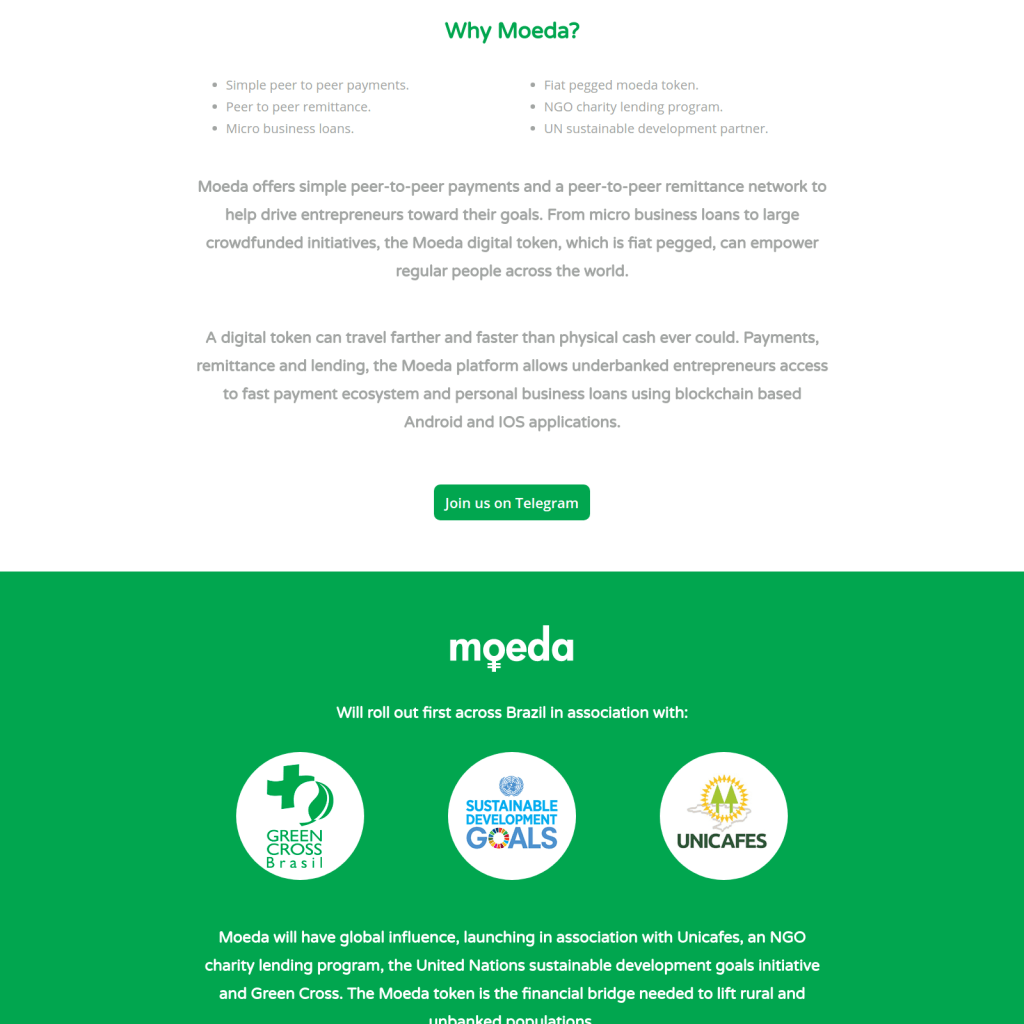
Moeda offers simple peer-to-peer payments and a peer-to-peer remittance network to help drive entrepreneurs toward their goals. From micro business loans to large crowdfunded initiatives, the Moeda digital token, which is fiat pegged, can empower regular people across the world.
General
Website: Visit
White paper: Read
ICO Time: 28 July 2017 - 28 Aug 2017
Country: Brazil
Token info
Ticker: MDA
Total supply: 19,628,888 MDA
Financial
ICO Price: ≈ 1 USD
Screenshots taken on 5 Feb 2018
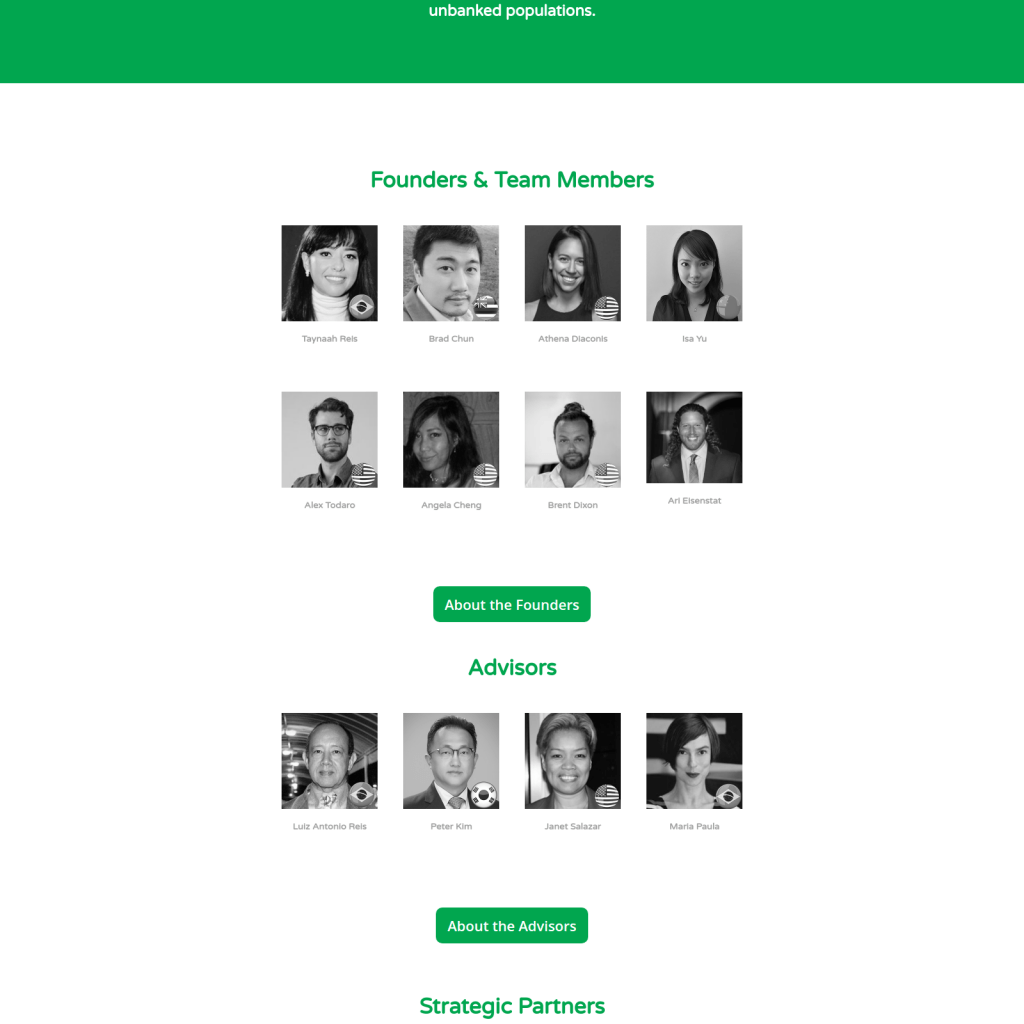
Alex Todaro
No participating data
Athena Diaconis
No participating data
Brad Chun
No participating data
Isa Yu
No participating data
Taynaah Reis
No participating data
Angela Cheng
No participating data
Vivian Hanai
No participating data
Brent Dixon
No participating data

Advisors (0)

ICO List
Other Interesting ICOs
Upcoming
Feniks
Feniks.Finance is a new financial blockchain based system, created on a fundamentally new concept, capable of scaling its speed as needed and adding new functionality. Feniks.Finance can be used as an international banking system for information transfer and payment execution. The first version of Feniks.Finance will be able to handle payments and storage of users' funds. Namely, the banking transactions labeled in the SWIFT system with MT103 as payment sent and MT202 as a receipt and crediting of the payment to the account. The next step in the development of the system will be a 700 group of SWIFT operations, namely documentary transactions better known as guarantees and letters of credit. The introduction of the 500 group, that is, the operation with securities, suggests that an exchange will appear in our network.
Upcoming
Quantler
Quantler is a blockchain for creating, analysing, sharing and running of decentralized structured investment products. Create structured products (such as an ETF) in equities or cryptocurrencies using themes. As there are a lot of the tokenized products being launched (currently over 1 900 available) the structured products for these assets are lacking behind (such as sector-based ETFs). Using Quantler’s blockchain anyone can create structured products (for regular assets such as Equities and cryptocurrencies) and run them on a decentralized network (much like smart contracts). Quantler also allows for regular assets, for this market Quantler’s solution is more flexible and has a lower costs base (targeted for exchanges, family offices and investment managers). The QUANT token’s intrinsic value is dependent on the AUM (asset under management) by the entire network. Quantler is like a Vanguard or BlackRock, but then in the form of a network.
Upcoming
Burency
Burency is an advocate for crypto and Blockchain adoption, particularly in the MIDDLE EAST. The platform is designed to address key challenges that prevent widespread adoption within the cryptocurrency and Blockchain ecosystem such as exchange’s lack of liquidity and security, unsustainable mining, unawareness of Blockchain applications to businesses. The Burency Exchange is a regulated exchange platform that addresses key challenges including security, liquidity, fiat to crypto transactions and vise versa, and more. The exchange is one of the world’s fully insured platforms, with coverage provided from LIoyd’s of London through the Nebbex Protocol. The Burency Mining facility answers some of the challenges associated with crypto mining such as mining destruction to environment and excessive mining power expenses by creating a sustainable facility powered by renewable hydropower. Burency provides a streamlined platform for the generation of cryptocurrency via purchased timeshare slots within the mining facilities using the BUY token. Additionally, computational power can also be purchased via the BUY token which governs purchases across the Burency ecosystem. The Burency Blockchain Development Center is dedicated mainly for advising enterprises on Blockchain applications and helping them operate on the blockchain for more efficient operation and business transactions execution. In particular, the center focuses on the creation of smart contracts that enable businesses to trade with entities across geographical and jurisdiction boundaries.
Upcoming
Constellation
The Constellation protocol implements a horizontally scalable blockchain architecture known as Extended Trust Chain with a peer to peer layer known as a gossip protocol that can be deployed on a mobile device. Constellation approaches smart contracts with a microservice architecture allowing for highly available services to be chained and composed into distributed applications with just an understanding of each microservice’s SLA (service level agreement) and/or type signature. This architecture ensures high transaction throughput, allowing for consumer grade distributed applications to be built on Constellation.
Upcoming
Acta Finance
The first Cross-Chain Interoperable DeFi Ecosystem, built natively on Avalanche The ActaFi Ecosystem brings a complete DeFi suite that incentivises user-base growth and motivates the user activity, offering both DeFi products and features in a single ecosystem. Every interaction within the ActaFi Ecosystem is executed on-chain, by smart contracts.
Upcoming
LOHN
Lohn is a widely spread contractual form in various industrial fields of international cooperation relations, especially in the industry of clothing, footwear, leather, furniture, software and hardware, pharmaceutical, metal working, metallurgical, machine tools, automotive, automation, machine building industry, electronics and appliance industry, food and beverage industry, petrochemical industry. The lohn (processing economy) has been and will be a solution to produce goods at reasonable and high-quality prices through the efficient use of labor and cheap raw materials in emerging economies. It is also a business model that creates economic and social progress across the world bringing together markets with productive resources and capabilities. The trading platform developed by the lohncontrol project will create global opportunities for small and medium-sized businesses that are responsible for generating 60% of GDP. It will give them a visibility that they do not have at this time and will encourage the development of direct business between them. This means low manufacturing costs and greater adaptation to market demands. Those who will win at the end of this interaction will be consumers who will get good products at realistic prices.