Bancacy

Bancacy

ICO Ended
6,035 Views
Bancacy is a innovative and decentralized digital asset class that is establishing new form of Money. The ecosystem utilize BNY/XBNY Cryptocurrencies for Asset Solidification, Investments and Passive Income in aspiration to deliver fully independent and immutable Digital Money powerd by the Blockchain.
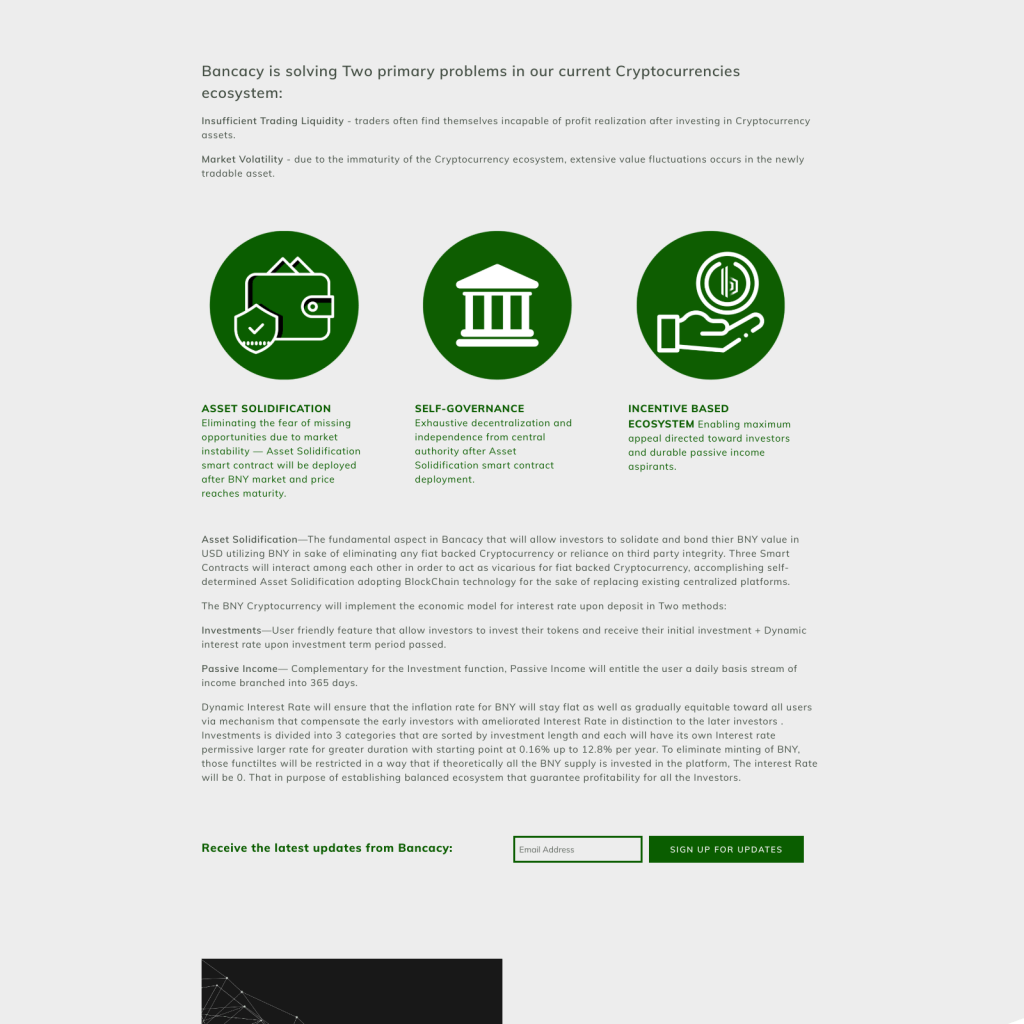
Bancacy (BNY) is solving Two primary problems in our current Cryptocurrencies ecosystem:
Insufficient Trading Liquidity - traders often find themselves incapable of profit realization after investing in Cryptocurrency assets;
Market Volatility - due to the immaturity of the Cryptocurrency ecosystem, extensive value fluctuations occurs in the newly tradable asset. Registered in Israel with legal opinion of Maltese law firm.
7.9
TOTAL SCORE
7.7
ICO PROFILE

(weight: 45%)

8
TEAM PROOF

(weight: 20%)

Get widget
General
Website: Visit
White paper: Read
ICO Time: 31 Aug 2019 - 09 Sept 2019
Country: Israel
Token info
Ticker: BNY
Platform: Ethereum
Token Type: ERC-20
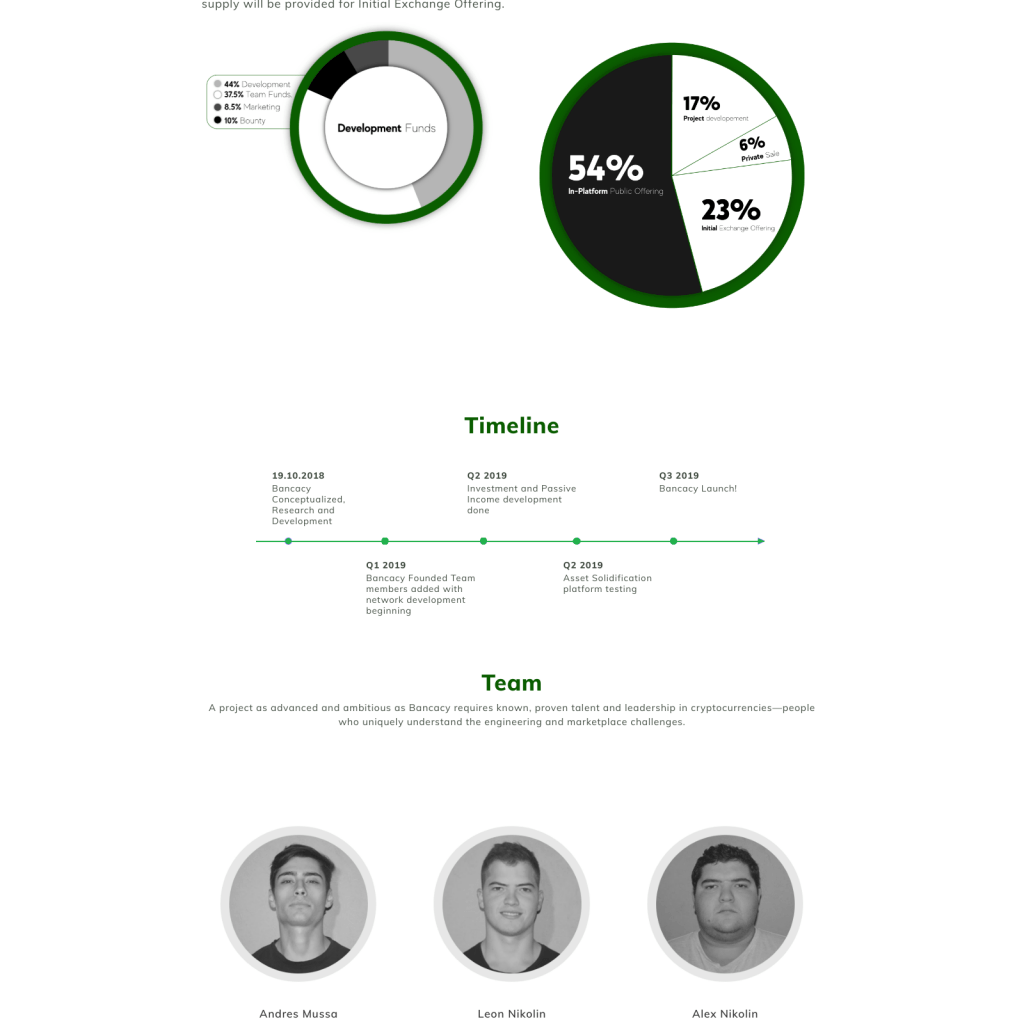
Available for sale: 534,600,000 BNY (54%)
Total supply: 990,000,000 BNY
Financial
ICO Price: 1 BNY = 0.00001852 ETH
Accepting: ETH
Q4 2018
Bancacy Conceptualized, Research and Development
Q1 2019
Bancacy Founded Team members added with network development beginning
Q2 2019
Investment and Passive Income development done.<br /> Asset Solidification platform testing.
Q3 2019
Bancacy Launch
Screenshots taken on 30 Aug 2019
Andres Mussa
Founder / Head of Software Development
Participates in a number of projects
Leon Nikolin
Chief Operating Office
Participates in a number of projects
Alex Nikolin
Chief Technology Officer / Blockchain Engineer
Participates in a number of projects
Eli Rashid
System Development Manager
Participates in a number of projects
Chris Whitlock
Senior Software Developer
Participates in a number of projects

Advisors (2)

Paddy Stash
Participates in a number of projects
Sean Gravano
Participates in a number of projects
HEIGHT - 0px
WIDTH - 0px
PUT THIS CODE TO YOUR WEBSITE
ICO List
Other Interesting ICOs
Active
Rivalz
Rivalz is redefining AI infrastructure by creating an AI Intel Layer to unlock new agentic economies. Built on a dual-chain DePIN architecture using Dymension and Arbitrum, Rivalz addresses one of the biggest bottlenecks in AI today: access to AI-ready, verifiable, and secure data. As we envision the web3 space to become agentic and overtake humans in the amount of transactions over time, what Rivalz is building is key for enabling this future. The core challenge that Rivalz is addressing is the need for AI-ready, verifiable and accessible data and later on intelligence. Rivalz offers a hybrid solution combining decentralized storage and high-speed agent-centric connectivity networks that cater specifically to AI's demands, ushering in the era of the agentic economy.
Upcoming
Sponsy
Sponsy is disrupting the sponsorship industry. It is a one-stop online solution for sponsors and sponsees to conduct sponsorship deals. By tokenizing sponsorship assets and decentralizing decision-making, we do not only reduce costs, but also provide sponsees with a wider choice of sponsorship opportunities and make sponsorships available to every business.
Upcoming
Co-DEX Exchange
Co-DEX is a Decentralized trading platform for cryptocurrencies, built on vanguard security infrastructure and using a revolutionary system. Co-DEX is an exchange created by the community, for the community, thus Co-DEX will be the first exchange that will apply a NO FEES policy on transactions, the users being required to cover solely the transaction cost of the miners and/or validators that register the action on the blockchains. Experience direct peer-to-peer trading without the security risk of trusting a third party, thus having complete control of your assets at any time.
Upcoming
Constellation
The Constellation protocol implements a horizontally scalable blockchain architecture known as Extended Trust Chain with a peer to peer layer known as a gossip protocol that can be deployed on a mobile device. Constellation approaches smart contracts with a microservice architecture allowing for highly available services to be chained and composed into distributed applications with just an understanding of each microservice’s SLA (service level agreement) and/or type signature. This architecture ensures high transaction throughput, allowing for consumer grade distributed applications to be built on Constellation.
Active
Origin Protocol
Origin is building a platform that enables the creation of many decentralized marketplaces, allowing buyers and sellers to connect and transact directly on the blockchain. The company is building a set of protocols, developer libraries, and a decentralized application using the Ethereum blockchain and IPFS, with an initial focus on disrupting sharing economy marketplaces. Origin's mission is to reduce or remove transaction fees, promote open and transparent commerce, redistribute value more fairly to buyers and sellers, and empower the 2 billion currently unbanked individuals around the world to participate in digital marketplaces.
Upcoming
LOHN
Lohn is a widely spread contractual form in various industrial fields of international cooperation relations, especially in the industry of clothing, footwear, leather, furniture, software and hardware, pharmaceutical, metal working, metallurgical, machine tools, automotive, automation, machine building industry, electronics and appliance industry, food and beverage industry, petrochemical industry. The lohn (processing economy) has been and will be a solution to produce goods at reasonable and high-quality prices through the efficient use of labor and cheap raw materials in emerging economies. It is also a business model that creates economic and social progress across the world bringing together markets with productive resources and capabilities. The trading platform developed by the lohncontrol project will create global opportunities for small and medium-sized businesses that are responsible for generating 60% of GDP. It will give them a visibility that they do not have at this time and will encourage the development of direct business between them. This means low manufacturing costs and greater adaptation to market demands. Those who will win at the end of this interaction will be consumers who will get good products at realistic prices.