QRL

QRL

TBA
12,740 Views
The concept of a peer-to-peer internet ledger of value, recorded as a blockchain and secured by proof of work was rst reported in 2008. Bitcoin remains the most widely used cryptocurrency to date. Hundreds of similar cryptocurrency ledgers have been subsequently created but with few exceptions they rely on the same elliptic curve public-key cryptography (ECDSA) to generate digital signatures which allow transactions to be varied securely. The most commonly used signature schemes today such as ECDSA, DSA and RSA are theoretically vulnerable to quantum computing attack. It would be valuable to explore the design and construction of a quantum resistant blockchain ledger to counter the potential advent of a sudden non-linear quantum computing advance.
5.6
TOTAL SCORE
5
ICO PROFILE

(weight: 45%)

1
TEAM PROOF

(weight: 20%)

Get widget
General
Website: Visit
White paper: Read
Dates: TBA
Token info
Ticker: QRL
Platform: Ethereum
Token Type: ERC20
Financial
Accepting: ETH
November 2016
White paper release. After discussion with developers, post-quantum cryptographers and research into existing roadmap of blockchain technology, the whitepaper was written to provide an overview of quantum resistant methodologies. The Winternitz OTS+ and Extended Merkle Signature Scheme (XMSS) were identified as the optimal solutions. This investigation also revealed the necessity of QRL to stand alone as a network with interoperability in the later pipeline.<br />
December 2016
Design of a proof-of-stake algorithm (POS) commenced
January 2017
Prototype node development with basic POS algorithm and integration of XMSS signatures
February 2017
Prototype node development with basic POS algorithm and integration of XMSS signatures
April 2017
Launch of the Alpha testnet with nodes running on MacOS, Linux, Windows on hardware including Raspberry Pi. Private seed presale round opens.
August 2017
Node optimization with C++. Inter-node encrypted communication (‘new hope’ lattice-based cryptography)
December 2017
Not willing to compromise a launch with an immature PoS protocol given how much value the project currently carries — and more importantly how much value it will hold in the future, QRL announces a move to temporary Proof of Work model.<br />
January 2018
Proof of Work public testnet is released to the public
February 2018
The introduction and solidification of variable key heights and signature space allows us to ensure future compatibility with almost anything. Our blockchain now includes the possibility to upgrade signature schemes (XMSS, SPHINCS, + future) and through an address format update, support different cryptographic hash functions (SHA2_256, SHAKE_128, SHAKE256 etc).<br />
March 2018
Our internal code review also compliments the more general internal security review we are currently in the process of conducting.<br />
March 2018
Audit Completed by red4sec with x41 doing a secondary audit for further scrutiny.<br />
June 2018
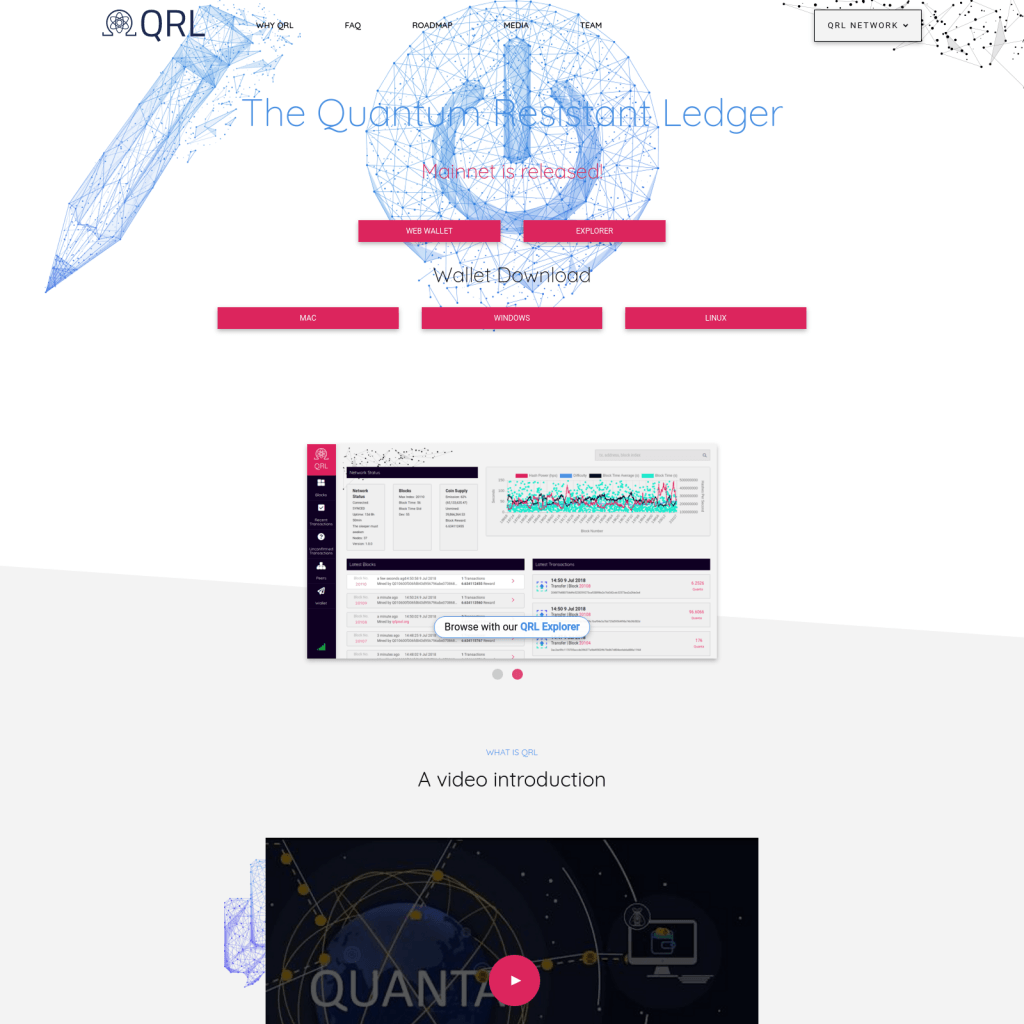
The QRL Main Network is officially Live!<br /> <br /> Block Explorer: https://explorer.theqrl.org/<br /> <br /> Web Wallet: https://wallet.theqrl.org/<br /> <br /> Desktop Wallets: https://github.com/theQRL/qrl-wallet/releases<br /> <br /> Release: https://qrl.foundation/assets/QRLF-PR-20180626.pdf<br />
Screenshots taken on 4 Oct 2018
Michael Kolenbrander
Core Developer Technical Solution Architect
No participating data
Elliott Gregory Dehnbostel
Marketing & Community Community Engagement
No participating data
Adam Koltun
Business Development Lead Business Strategist
No participating data
Scott Donald
Core Developer Full Stack Developer
No participating data
Luke Hahn
Design Lead UI / UX Designer
No participating data
Jack Matier
Marketing & Community Community Support
No participating data
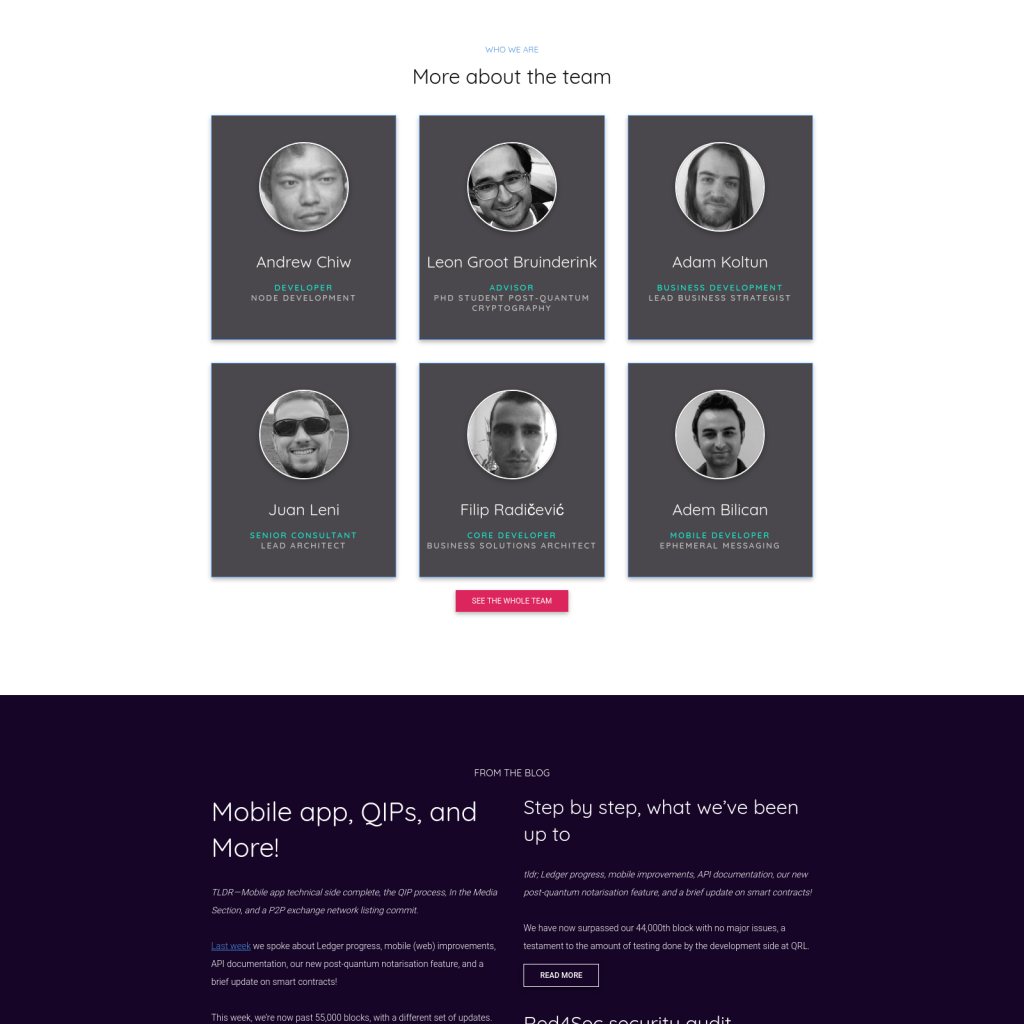
Andrew
Chiw Developer Node Development
No participating data
Kaushal Kumar Singh
Core Developer Blockchain Developer
No participating data
JP Lomas
Core-Developer Full stack developer
No participating data
Adem Bilican
Mobile Developer Ephemeral Messaging
No participating data
Juan Leni
Senior Consultant Lead Architect
No participating data
Peter Waterland
Core Developer Founder
No participating data
Aidan Beale
Developer Node GUI
No participating data
Filip Radičević
Core Developer Business Solutions Architect
No participating data
James Gordon
Documentation Lead Technical Writer/Analyst
No participating data

Advisors (1)

Leon Groot Bruinderink
Advisor PhD student Post-quantum Cryptography
No participating data
HEIGHT - 0px
WIDTH - 0px
PUT THIS CODE TO YOUR WEBSITE
ICO List
Other Interesting ICOs
Upcoming
Little Phil
Powered by blockchain technology, the little Phil platform is an entirely new way of giving that fixes trust issues with charities using a public ledger, smart contracts and unique digital identities (UDID) to provide givers with the Proof of Need and Proof of Impact required to re-establish trust in giving to charity. Little Phil uses blockchain technology and user experience (UX) designed around a positive psychology framework to allow people to have the oversight, control and emotional connection of a philanthropist, without giving large amounts. People are able to give on their terms through their smartphone and track their giving all the way to the moment it’s received. This will create an engaging experience that makes them genuinely feel the positive impact they have had on their cause. In addition to this, charities will have solutions to their fundraising and exploitation concerns at a much lower cost than they currently incur.
Upcoming
Feniks
Feniks.Finance is a new financial blockchain based system, created on a fundamentally new concept, capable of scaling its speed as needed and adding new functionality. Feniks.Finance can be used as an international banking system for information transfer and payment execution. The first version of Feniks.Finance will be able to handle payments and storage of users' funds. Namely, the banking transactions labeled in the SWIFT system with MT103 as payment sent and MT202 as a receipt and crediting of the payment to the account. The next step in the development of the system will be a 700 group of SWIFT operations, namely documentary transactions better known as guarantees and letters of credit. The introduction of the 500 group, that is, the operation with securities, suggests that an exchange will appear in our network.
Upcoming
Emrify Health Passport
Emrify is launching a decentralized Personal Health Record platform on top of the Ethereum public blockchain to deliver trusted health information to the right hands at the right time anywhere in the world. With years of building consumer engagement mobile apps, Emrify is laser focused on collecting and locking up data for each person for complete ownership and control to freely share their data. Our top priority is to create attractive cryptoeconomics models to incentivize health data sharing for all parties. With strategic US partnerships with hospitals and doctors, Emrify is building on top of established prototypes to accelerate the launch of production interfaces to firmly establish the Utility Token in healthcare.
Active
Zillios
Zillios is the next generation international real estate platform, revolutionary and highly innovative. Zillios completely changes the way the real estate market operates providing a state of the art scalable infrastructure to all key stakeholders, including smart contract based features to tackle current inefficiencies in rental and buying processes. Blockchain-based property transfer is foreseen in Zillios´ technology providing a future-proof infrastructure.
Upcoming
Moonlighting
Based in the United States, Moonlighting is a 3-year-old freelance marketplace with a proven track record of empowering people to earn extra money and hire talented professionals quickly. With the integration of blockchain technology Moonlighting will decentralize worker profiles, reward participation, and make hiring and working in the freelance economy trusted, global, and inclusive.
Upcoming
SID Token
SID (Share Internet Data) is a peer-to-multi-peer decentralized internet sharing system that allows sharing internet from one person's smartphone to another nearby in an automated manner. One of our key missions through the SID project : “To lift as many people as possible out of poverty by means of giving the less fortunate a way to access the Internet”. Certain users will be able to get free Internet access by obtaining tokens in exchange of consuming advertising. Such obtained tokens can then be used to consume internet megabytes from other nearby Users in exchange for tokens OR Users will simply trade some of their tokens directly with other SID Users. Those trades will be done simply through a secured blockchain, on a public exchange to ensure full transparency with the control of the tokens and the control of sharing internet or not fully decentralized, meaning solely under end-user’s control through their post ITO (Initial Token Offering) token Wallet inside the SID App.